Wairakei Turbines and Generators
The generation of electricity at the Wairakei Power Station is achieved through four different turbine-generator types. This variety of machines is necessary because geothermal fluid is a natural product and therefore varies.
The ways in which the geothermal fluid varies are
- the mass flow rate, pressure and volume of steam available
- the proportion of steam to hot water
- the ageing and use of the geothermal field
- improvements in bore technology
- environmental factors
The variety of these turbine-generator pairs is shown in the table below. Note there is presently a total of 10 generators currently operating with an 11th 'Binary Plant' under construction.
| Generator Number | Location | Turbine | Generator |
| G1 | Station A | Intermediate Pressure | 11.2 MW 3000 rpm 2pole |
| G2 | Station A | taken out of service in 1984 | - |
| G3 | Station A | Taken out of service in 1984 | - |
| G4 | Station A | Intermediate Pressure | 11.2 MW 3000 rpm 2pole |
| G5 | Station A | Removed to Ohaaki in 1984 | - |
| G6 | Station A | Removed to Ohaaki 1984 | - |
| G7 | Station A | Low Pressure | 11.2 MW 3000 rpm 2pole |
| G8 | Station A | Low Pressure | 11.2 MW 3000 rpm 2pole |
| G9 | Station A | Low Pressure | 11.2 MW 3000 rpm 2pole |
| G10 | Station A | Low Pressure | 11.2 MW 3000 rpm 2pole |
| G11 | Station B | Mixed Pressure | 30 MW 1500 rpm 4 pole |
| G12 | Station B | Mixed Pressure | 30 MW 1500 rpm 4 pole |
| G13 | Station B | Mixed Pressure | 30 MW 1500 rpm 4 pole |
| G14 | Stand Alone | Intermediate Low Pressure | 4 MW 1500 rpm 4 pole Uses an asynchronous, induction generator |
| Binary Plant | Stand Alone | High Pressure | 14 MW Under construction |
The Types of Wairakei Turbines
1. Low Pressure Turbines
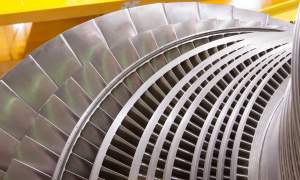
In a Low Pressure turbine the steam enters in the centre and flows out towards the ends through five stages of blading, before being drawn into the condenser below.
The term 'Low Pressure' means that the steam is only at 1.1 atmosphere pressure (0.1 bar gauge pressure). Although this is just above normal atmospheric pressure, the steam is able to drive the turbine because the condenser creates a vacuum on the output side, effectively sucking the steam through.
Wairakei Power Station has 4 Low Pressure steam turbines that all drive 2-pole generators at 3000 rpm.
2. Intermediate Pressure turbines
Wairakei Power Station has 2 Intermediate Pressure steam turbines that both drive 2-pole generators at 3000 rpm.
The steam enters the turbine at 3.5 Bar of pressure and flows from the front towards the rear, pushing against 3 different stages of blading.
3. Mixed Pressure Turbines
In
a Mixed Pressure Turbine the same turbine is
driven by one steam pressure and then another.
Wairakei Power Station has 3 Mixed Pressure steam
turbines that drive 4-pole generators at 1500
rpm.
The first pressure is Intermediate Pressure steam at 3.5 Bar, which enters the turbine in the centre. The steam then pushes against 8 consecutive rows of blades, as it travels towards the front of the turbine. The pressure of the steam when it exhausts this inner casing is about 1.1 Bar, it is then turned around and flows back towards the generator between the inner and outer casings. Low pressure steam is added through another set of throttles. The steam goes through another 7 sets of blades before exhausting into the condenser.
4. High Pressure Turbines
The original High Pressure turbines have been removed from the Wairakei Power Station because the high pressure steam (12 bar or atmospheres pressure ) is no longer available from the geothermal field. These turbines are now used for generation at the Ohaaki Power Station.
5. The Binary Plant
The Binary Plant is still under construction and will use heat energy in waste hot water to drive two 8 MW generators. However the binary plant needs about 2MW of power just to run its own pumps and fans so the overall generation is 14MW.
As
the condensers are air cooled, the weather will
have a big effect on output. They will be able
to generate about 4MW more on a frosty night
than a hot summer's day.
The Binary Plant uses hot water to heat the low
boiling point (29°C) liquid Iso-pentane The
Iso-pentane gas is used to drive the turbine
and generator.
This is done by:
- pumping the Iso-Pentane through a heat exchanger, at high pressure (11 Bar)
- allowing the Iso-Pentane to boil
- using the Iso-Pentane gas to drive a turbine
- cooling and condensing the Iso-Pentane
- repeating the process
The Binary plant has these advantages:
- an extra 14 MW of power is generated which is enough to supply about 10,000 homes.
- cooling of the waste water makes is easier to remove dissolved contaminants such as Arsenic, Lithium and Silica
- it does not affect the supply of geothermal water used by others.
Condensers
Condensers rapidly condense steam that is leaving the turbine. This causes a vacuum to form that effectively 'sucks ' the steam through the turbine, while it is being 'pushed' from the input side.
A condenser doubles the power output of the turbines and generators. At Wairakei the condensers are simple large open chambers into which river water is sprayed.
The cooling of the steam to form water releases a great deal of heat energy, mainly because it involves a change of state from gas to liquid. It takes 40kg of cool Waikato River water to condense each kg of steam.
The vacuum in a condenser is maintained using a Barometric Leg, which is a large column of water beneath the condenser through which the cooling water drains into the Waikato River. This allows the water to leave the condenser without it having to be pumped.
Non Condensable Gases
To create a complete vacuum in a condenser all gases must be removed. This is difficult however because gases such as oxygen, carbon dioxide and hydrogen sulfide are dissolved in the geothermal steam and cooling river water.
As the pressure drops within a condenser it encourages these dissolved gases to come out of solution and become free gases. This can commonly be seen when a cap is removed from soft drink bottle and the bubbles of carbon dioxide escape leave the drink. The bubbles remain as gases because the temperature is too high for them to condense into liquids. This explains the term Non Condensable Gases or NCG's for such gases. NCG's reduce the condensers efficiency at Wairakei, so they are pumped from the top of the condenser and ejected into the air above the power station.
At Wairakei about half of the non condensable gases are from the steam. The rest is water vapour and gases that were dissolved in the cooling water. In particular the two gases in the geothermal steam, carbon dioxide and hydrogen sulfide, are partly soluble and about half are absorbed into the cooling water and discharged to the river.