New Zealand
Geothermal Association (Inc.)
 
 New Zealand Geothermal Fields

Geothermal systems occur in many parts of New Zealand. High temperature geothermal fields are principally located in the Taupo Volcanic Zone, with another high temperature field at Ngawha in Northland. Moderate to low and very low temperature systems are more widely scattered. Some are associated with areas of young volcanism: in Northland, Hauraki Plains, and the coastal Bay of Plenty. Many hot springs, particularly in the South Island, are associated with faults and tectonic features.

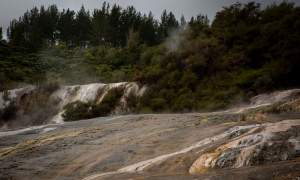
Steaming geothermal lake at WaiotapuBy the 1980s it was believed that all of New Zealand's high temperature geothermal resources had been identified, a situation that few other countries can claim even today. Of New Zealand's 129 identified geothermal areas, fourteen are in the 70-140ºC range, seven in the 140-220ºC range and fifteen in the >220ºC range.

The Taupo Volcanic Zone extends from White Island in the Bay of Plenty southwest to Mt Ruapehu. Geothermal fields are associated with young and active rhyolitic volcanism. Magma intruded into the stretched and fractured crust of the zone has resulted in temperatures of at least 350ºC at depths of less than 5 km. This has provided a huge heat source from which geothermal systems have developed and been sustained for periods of up to hundreds of thousands of years. A total of 29 geothermal areas have been identified, although only about half of these have potential for resource utilisation. Individual fields are typically about 12 sq km in area and spaced 15 km apart, and include all those in New Zealand that discharge boiling water.

An independent company has recently undertaken a comprehensive review of geoscientifc data from the Hauraki region and Taupo Volcanic Zone and is conducting supplementary surveys. This review may have identified new potential geothermal resources that have no surface expression.

Back to Top

Links

http://www.eeca.govt.nz/renewable-energy/maps-geo.html
http://www.ew.govt.nz/enviroinfo/geothermal/fieldsmap/index.htm
http://www.envbop.govt.nz/water/geothermal/geothermal-resource.asp

Ngawha

The Ngawha geothermal field is located 6 km east of Kaikohe in Northland and is the only high temperature geothermal field outside the Taupo Volcanic Zone. The surface expression of the underground system at Ngawha is small and includes a number of small fossil sinter deposits, two large areas of hydrothermal clay deposits and about 20 hot springs near Ngawha village. Natural geothermal activity is characterised by the large volume of gas (mainly CO2) given off over the field. Mercury vapour is also given off, and mercury deposits exist within and adjacent to the field.

Geothermal investigations at Ngawha began in the 1960s, including the first well. Sixteen other wells were drilled between 1977 and 1983 to depths ranging from 600 to 2300 m. The investigations identified a large but relatively low enthalpy resource with the wells producing fluid at 225-230°C with high levels of dissolved minerals including boron and mercury. Thirteen of the wells were tested, of which six were good producers with a mean fluid enthalpy of about 975 kJ/kg. Gas ratios suggest that a deeper reservoir at 300-320°C is contributing to the system and one well proved these temperatures exist.

The current development at Ngawha is a joint venture between local Maori interests and Top Energy which commissioned two 4.5 MW binary units in 1998. Resource consents were granted for only a 12 year period on the condition that development should not cause any detectable changes to the surface features because of their high cultural value. Further expansion of the Ngawha project is just underway with Top Energy bringing the project up to a total of 25 MW. The expansion will include additional Ormat binary cycle units.

Ngawha is a large energy resource with significant investment in unused production wells. The relatively low heat content, the high levels of dissolved material in the fluids and high gas content produced from the wells (more than would be produced from a gas-fired power station for the same output) are drawbacks for electricity generation. Of greater concern is the need to protect the surface features. The potential for industrial process heat and tourism has been investigated by a number of groups. The field is regulated by Northland Regional Council.

Back to Top

Wairakei-Tauhara

The Wairakei-Tauhara geothermal system includes the Wairakei geothermal field located 8 km north of Taupo and the Tauhara field to the southeast, with the boundary between the interconnected fields placed at the Waikato River. The Wairakei field is exploited by the Wairakei,Poihipi Road, and Wairakei Binary power stations.

The Wairakei station was first commissioned in 1958 and is now owned by Contact Energy. The field has been a consistent and reliable producer, with annual generation averaging 1250 GWh equivalent to a load factor of 93%. Present output is 140 MWe. At least 150 wells have been drilled in the field. The maximum temperature measured at Wairakei is 271 °C, but wells generally produce fluid at temperatures between 209 and 261°C. About 5300 tonnes of fluid per hour is currently taken from the reservoir for this station. Of this fluid, about 1500 tonnes per hour is steam and 3800 tonnes per hour is water at a temperature of about 130°C after separation in surface equipment. Some of the steam is taken directly from shallow dry steam production wells (up to 500 m depth) and piped to the turbines. Separated water from the Wairakei field is used to provide fluids for the Netcor tourist facility, and a heat source for a prawn farm adjacent to the Wairakei power station. About half of the separated water is now reinjected and half is discharged to the Waikato River. All steam condensate is discharged to the river.

The Poihipi Road station was commissioned in 1996 and is sited on the edge of the Wairakei field. The generator consists of a single condensing steam turbine fed by four dry steam wells. It was developed by a Taupo entrepreneur and is now owned by Contact Energy and operated as an integral part of the Wairakei facility. Although the plant has a capacity of 55 MWe, resource consent restrictions on steam draw down limit production to an average of about 24 MWe. In practice it is operated as a two shift station with an output of about 29 MWe during the day when electricity prices are higher, and at about 19 MWe at night. The station currently generates around 200 GWh per year. About half of the steam condensate is reinjected while the remainder is discharged to air through the cooling towers.

The Wairakei Binary Cycle power station was commissioned in 2005 and generates an additional 14.4 MWe from the separated water before reinjection or use by the prawn farm.

Liquid drawdown from the Wairakei reservoir has caused a loss of pressure in the Tauhara field and the formation of steam zones over a large portion of the field, especially in the Karapiti area in which the 'Craters of the Moon' thermal area is situated. Other surface effects of this drawdown have been a decline in the flow of chloride springs, an increase in the extent and temperature of the shallow aquifers and hot ground in Tauhara, and the occurrence of a number of shallow hydrothermal eruptions to the northeast of Taupo township. Subsidence has also occurred in an area between the borefield and the Wairakei station, and some local subsidence north of Taupo may be geothermally related.

Steam production from the older parts of the Wairakei field has declined. Periodic drilling of make-up wells allows steam production to be maintained. Since 1985, the steam zone which formed in the western part of the field as the result of drawdown has been exploited with shallow wells.

At Tauhara, the shallow steam-heated aquifer that underlies part of Taupo township and land further to the east and north has been extensively exploited, with over 400 shallow wells extracting heat or steam or water for domestic, commercial and other uses. Contact Energy commissioned a new 20 MWth process heat supply to Tenon for kiln drying in 2006. Four deep wells drilled at Tauhara have found higher temperatures than Wairakei, adding to the evidence for multiple upflows. The maximum temperature recorded is 279°C. Production temperature is 265 °C.

Contact Energy is now considering new arrangements for the Wairakei-Tauhara resource including possible replacement of the existing Wairakei station and development of a new 200 MW station at Tauhara. Development will have to take into account potential adverse environmental effects on the surrounding Taupo urban area.

Field use is regulated by Environment Waikato.

Back to Top

Ohaaki-Broadlands

The Ohaaki-Broadlands geothermal field is located 20 km northeast of Taupo immediately south of State Highway 5. The Ohaaki power station, with its conspicuous 105 m high cooling tower, was commissioned in 1989 and is owned by Contact Energy. The station had a capacity of 114 MWe (although the station has had a series of deratings including decommissioning of high pressure turbines) produced from twenty-five wells extracting around 1500 t/hr of fluid from the Ohaaki area of the field. Steam production has continued to decline due to cool water from the field margins encroaching on production wells, and output has declined to about 40 MWe. Several new wells have been drilled to restore and maintain production at the 50MWe level.

There have been significant environmental effects at Ohaaki, including subsidence leading to flooding. The water rights granted for the station specified waste water re-injection at depth to avoid contaminating the Waikato River or adjacent groundwater.

Wood drying kilns use waste geothermal energy directly as a heat source for the drying process.

Field use is regulated by Environment Waikato.

Back to Top

Rotokawa

The Rotokawa geothermal field is located about 14 km northeast of Taupo and 9 km east of Wairakei. The associated thermal area has extensive surface features including fumaroles, eruption craters and collapse pits. Lake Rotokawa fills one crater, and there are large deposits of sulphur surrounding and beneath the lake.

The energy potential of Rotokawa was recognised in the early 1950s. Drilling has identified a large high-temperature resource of about 18 sq km with an energy potential estimated at least 250 MWe. Production is from around 2000 - 2500 m with temperatures up to 320°C.

The 29 MWe Rotokawa power station (an Ormat geothermal combined cycle station) was commissioned in 1997 (and subsequently expanded to 35 MWe in 2003). The Rotokawa project is divided into two companies; Rotokawa Joint Venture (a 50:50 joint venture between Tauhara North No.2 Trust and Mighty River Power) which owns the steamfield, and Rotokawa Generation (100% Mighty River Power) which owns the generation plant. Mighty River Power operates both the station and the steamfield. Annual generation is about 250 GWh.

There are no readily identifiable environmental constraints to development. Hydrothermal eruptions have occurred in the past at Rotokawa, and drawdown due to a large development may increase the probability of further eruptions. Shallow acidic fluids have posed problems for well casing. The field is classified as open to development by Environment Waikato subject to the resource consent process.

Rotokawa is well located, with Taupo, Ohaaki and existing transmission lines close by. The field is close enough to Wairakei, Tauhara or Taupo township to make piping steam to those sites a possibility.

Back to Top

Mokai

The Mokai geothermal field is located 20 km north of Taupo, remote from geothermal tourist attractions. The field lacks the spectacular thermal activity present at many other fields, consisting only of small areas of steam-heated activity.

Expanded Mokai Development (Mokai II in the foreground)Geoscience and drilling in the 1980s indicated the potential of the Mokai field. The field has some of the hottest geothermal wells in New Zealand with downhole temperatures of up to 326°C recorded. One well was capable of generating 25 MWe. The high reservoir temperatures mean that wells tend to produce high steam content fluids with high chloride and silica content. Energy potential is estimated at greater than 100 MWe.

The Mokai power station was commissioned in 2000. It is the first in New Zealand to be fully owned by a Maori trust (the Tuaropaki Trust which subsequently placed assets in the Tuaropaki Power Company), with Mighty River Power contracted to operate and maintain the Ormat geothermal combined cycle station which has installed capacity of 55 MWe. Mighty River Power has recently bought a 25% share in Tuaropaki Power Company. All condensate and cooled brine is reinjected. A 39 MWe expansion of similar design was commissioned in 2005, and a large geothermally heated greenhouse complex has been developed nearby. A further binary unit has just been installed at the station to take account of the changing steam/water ratios due to the effects of exploitation.

The field is classified as open to development by Environment Waikato subject to the resource consent process.

Back to Top

Kawerau

The Kawerau geothermal field is located immediately east of Kawerau township. Most of the surface thermal features are believed to have been in a natural state of decline prior to development, which arose from the energy requirements of the large Tasman pulp and paper processing plant built in the 1950s.

Seventeen wells (including redrills) had been completed by the end of 1957 when Kawerau became the first production field in New Zealand. In the late 1950s four of the wells were deepened following a decline in field production and further drilling commenced in 1966 after continued field decline. The Crown had an active drilling program from the mid-1970s through to mid-1980s, aimed both at maintaining steam supply to the mill and investigating a major expansion for power generation or other process steam supplies. Wells have required frequent cleanouts of calcite scale. New wells have occasionally been drilled to maintain supplies. Until the commissioning of the Ohaaki power station at Broadlands-Ohaaki, Kawerau was the second largest producing field in New Zealand and its steam supply for industrial use equates to half of the worlds total steam supply for industrial applications.

Downhole temperatures recorded in the field range from 250 to 310°C. A total available resource greater than 350 MWe has been estimated. Around 270 tonnes per hour of steam is provided to the Norske Skog Tasman mill where it is used for process heat, electricity generation and timber drying. In addition, Bay of Plenty Electricity operate two binary plants rated at a total of 6 MWe which use some of the separated geothermal water as a heat source. These are linked to separator plants physically either side of the Tarawera River. In 2004, Norske Skog Tasman replaced their existing geothermal turbo-alternator with a refurbished ex-US Navy 8 MWe turbo-alternator.

Wells at Kawerau tend to suffer rapid run-down due to mineral deposition and cold water inflow. Various measures are used to maintain output. Production from the field has adversely affected the already declining natural features. Most waste water from the field is discharged into the Tarawera River after passing through a cooling channel, and current resource consents require ongoing efforts to reduce brine discharge. Re-injection of a limited quantity of fluid is undertaken. Future development options at Kawerau are constrained by the need to maintain steam supply to the Tasman processing plant. From 2004, Mighty River Power began an exploration programme in a new area of the Kawerau field. In 2005, a consent application was lodged by Mighty River Power for the development of a 70-80MW power station (See external site). Consents have been granted and Mighty River Power is now installing the largest single condensing geothermal turbine in New Zealand’s history.

In July 2005 after careful negotiation, the Crown transferred wells, steamfield equipment and contracts to Mighty River Power, who had a back-to-back transfer arrangement with Ngati Tuwharetoa Geothermal Assets. The negotiations involved a balancing of government commitments, Treaty obligations and commercial interests. The transfer marks a change from what has been a caretaking role to a development focus.

The resource is regulated by Environment Bay of Plenty.

Back to Top

Rotorua

The Rotorua geothermal field underlies much of Rotorua City and the southern margin of Lake Rotorua. The natural features associated with the field, particularly the geysers and hot springs of Whakarewarewa, are one of New Zealand's foremost tourist attractions. Whakarewarewa has the largest remaining concentration of geysers in New Zealand. There are also thermal features at Kuirau Park, Government Gardens, Ohinemutu, and Sulphur Point. A hot spring on Mokoia Island, and several warm springs at Lake Rotokawa are probably also associated with the field.

More than 900 shallow wells have been drilled at Rotorua to provide hot water for private homes, hospitals, schools, motels, hotels, and other commercial and industrial uses. At peak use, around 430 wells were operating. Currently less than 300 are operating. About 90 of the wells are less than 200 m deep and typically recover geothermal fluid at temperatures of 120 to 200°C. The development of the field has been carried out in an unplanned way and although the domestic, commercial and industrial heating systems that were developed were generally cost-effective, they were also inefficient and were characterised by their wastage of geothermal heat.

In the late 1970s there were significant changes to the surface features at Whakarewarewa and there were concerns that this was related to a decline in the geothermal aquifer pressure resulting from the level of draw-off from the Rotorua wells. In 1982 the Government set up a programme to monitor the geothermal reservoir. Initial work under the monitoring programme established that the output from the production wells represented a net withdrawal from the aquifer equivalent to a total mass flow rate of between 30,000 and 35,000 tonnes per day of geothermal fluid. This compared with a natural discharge of around 8000 tonnes per day from Whakarewarewa.

In 1985 the then Ministry of Energy published a comprehensive report concluding that there had been a dramatic decrease in natural activity at Whakarewarewa, including a 30% drop in natural heat flow between 1967 and 1985. The Government responded by embarking on a programme of compulsory well closure within 1.5 km of Pohutu Geyser. A field management regime was also put in place. By 1990, less than 150 wells were still operating at Rotorua. Since the completion of the programme, the water level in the main production aquifer has largely recovered and natural features are recovering.

Ultimately it may be possible for some alternative use of geothermal energy at Rotorua such as the use of downhole heat exchangers and district heating schemes. The potentially large resource is unlikely to be used for electricity generation because of the effect this would have on the Whakarewarewa geyser field. The resource is regulated by Environment Bay of Plenty.

Back to Top

Tikitere

The Tikitere geothermal field is located about 18 km northeast of Rotorua City on the southeast shore of Lake Rotoiti and comprises the Tikitere geothermal area and the Ruahine Springs several kilometres to the northeast. Thermal features included steaming ground, boiling springs and vigorous steam and gas discharges. The Hell's Gate thermal area is a popular tourist attraction

Several shallow wells that discharged steam and hot chloride water have been drilled close to Hell's Gate and have temperatures estimated at 140 to 190°C. Energy potential of the field has been estimated at greater than 160 MWe, but significant production could affect the natural features of the field. The Tikitere Trust which operates the Hell's Gate facility is investigating a limited development for electricity generation. The field is regulated by Environment Bay of Plenty.

Back to Top

Ngatamariki

The Ngatamariki geothermal field is located 5 km south of Orakeikorako and 20 km north-northeast of Taupo. This undeveloped field has been explored by wells drilled in the 1980s which identified a substantial geothermal resource with downhole temperatures of 270-280°C being recorded. Further work is required to fully define the size of the resource. Energy potential is estimated at greater than 140 MWe.

Most of the geothermal field is planted in exotic pine forests. The natural surface geothermal features are located at the Ngatamariki hot springs where sinter, pools and hot springs are part of a reserve administered by the Department of Conservation. A hydrothermal eruption was reported in 2005. The field is classified as open to development by Environment Waikato subject to the resource consent process.

Back to Top

Mangakino

The Mangakino geothermal field is located east of Mangakino township. At least one boiling spring was known at Mangakino but is now submerged by Lake Maraetai. Resistivity surveys have identified a low resistivity anomaly. Other investigations have also been carried out, and one well was drilled by the Crown to about 600 m which produced a highly gaseous discharge. The area has been recently investigated by Mighty River Power. While details are confidential, it is known that very high temperatures were encountered but formations were relatively impermeable. A fresh assessment of potential is needed. The field is classified for development by Environment Waikato.

Back to Top

Horohoro

The Horohoro geothermal field is located about 15 km southwest of Rotorua City. The thermal waters of the surface features are very dilute, and geothermometry suggests temperatures of 150 to 160°C in the aquifer. A very large low resistivity anomaly identified to the west of the Horohoro rhyolite dome and extending beneath the Mamaku Plateau is believed to be the result of hydrothermal alteration or to be a conductive ignimbrite. Several shallow wells drilled just south of the Horohoro dome recorded a temperature gradient much lower than that measured in the 600 m deep well in the Matahana Basin. The field is classified as open to development by Environment Waikato subject to the resource consent process.

Back to Top

Atiamuri

The Atiamuri geothermal field is located north of the Waikato River between Atiamuri and Ohakuri and about 40 km north of Taupo. Several hot springs and pools with temperatures up to 73°C are found in this area and two other pools have been submerged by Lake Atiamuri. The two main pools produce dilute chloride water which is used to supply thermal baths. Geothermometer temperatures indicate deep source temperatures of 180 to 200°C.

One well has been drilled at Atiamuri, about 1 km southwest of the main pools. The well encountered a maximum temperature of 165°C between 350 m and 600 m depth. There is no known evidence for a high-temperature resource at Atiamuri. The resource may be useful for small-scale direct heat processing of local agricultural or forest products. The field is classified as open to limited development by Environment Waikato subject to the resource consent process.

Back to Top

Tokaanu-Waihi

The Tokaanu-Waihi geothermal field is located at the southern end of Lake Taupo about 10 km northwest of Turangi. There are two main areas of thermal activity. At Tokaanu the thermal activity is characterised by chloride hot springs, pools and a geyser. Further west at Hipaua, fumaroles are present on the cliffs above Tokaanu while at Waihi there is an area of steaming ground and acidic springs. Springs occur on the shore of Lake Taupo.

Hot chloride springs at Tokaanu and Waihi have long been used for domestic purposes and recreational bathing, but otherwise the field is essentially undeveloped and the subsurface structure and extent of the field is poorly known.

High-temperature fluids are believed to exist at depth. A number of shallow holes have been drilled to obtain hot mineral water for the thermal baths and for commercial and domestic heating, and several holes were drilled for site investigations for the Tokaanu Powerhouse and tailrace. At Tokaanu two shallow wells have temperatures of 154°C at 76 m and 169°C at 107 m, and geothermometer temperatures indicate a deep hot fluid of at least 250°C.

Decrease in the natural thermal activity at Tokaanu has been related to changes in water levels in Lake Taupo, and also to the effects of shallow wells. Any deep drilling and production could further decrease this activity. Waihi could also be affected. It has been suggested that the chloride waters at Tokaanu are an outflow from the same source as the steam-heated Ketetahi hot springs on Mt Tongariro, and if it is established that the fields are connected, the possible effect of exploitation at Tokaanu-Waihi on the natural features at Tongariro would have to be assessed.

The energy potential of the field is estimated at greater than 150 MWe, but development potential remains uncertain. Further development requires the location of the deeper hot water source. The field is classified as open to limited development by Environment Waikato subject to the resource consent process.

Back to Top

Waiotapu

The Waiotapu geothermal field is located at the northern end of the Reporoa Valley, 23 km south-southeast of Rotorua City. The field has the largest area of surface thermal activity in New Zealand with a variety of features including geysers, large hot pools, small lakes filling craters, extensive sinter deposits, hot streams, mud volcanoes, and altered and steaming ground. Waiotapu has been a major tourist attraction for about one hundred years.

Wells drilled in the 1950s and 1980s recorded high temperatures up to 295°C but suffered poor discharge and extensive calcite deposition. Geothermal fluid was used for timber treatment for several years until the well was forced to close when refused a water right on the basis that discharging the well could potentially affect the natural features in the nearby Waimangu field. Limited fluid is still used by Arataki Honey and a hotel for a range of uses.

The energy potential of the field is estimated at more than 440 MWe, but the field is classified as protected by Environment Waikato.

Back to Top

Waimangu-Rotomahana

The Waimangu-Rotomahana geothermal field is located 22 km southeast of Rotorua. Lake Rotomahana fills the site of the largest craters formed by the 1886 eruption along the Tarawera rift. The site had formerly been occupied by an intensively active geothermal field which included the famous pink and white terraces. The Waimangu field thermal area and the activity at Lake Rotomahana formed after the 1886 eruption. Like Waiotapu, Waimangu has been a major tourist attraction for over one hundred years.

Waimangu is unique in the New Zealand setting in that surface geothermal activity began after the 1886 eruption so began in historic times. In the early years a large geyser used to play but ceased many years ago.

Thermal activity includes geysers, spouters, hot and boiling pools and streams, mud pools, steaming ground and hydrothermal eruptions. Upwellings of hot water occur within Lake Rotomahana. There is strong geophysical and chemical evidence supporting a connection between Waimangu and Waiotapu.

The energy potential of the field exceeds 180 MWe, but the field is classified as protected by Environment Waikato.

Back to Top

Orakeikorako

The Orakeikorako geothermal field is located about 23 km north of Taupo and 37 km south-southwest of Rotorua City. In 1961 the Waikato River was dammed downstream of the field, creating Lake Ohakuri which flooded most of the surface features, including many of the geysers and sinter deposits. Although the remaining hot springs and pools, geysers, sinter deposits, fumaroles and steaming ground are only part of what was once a spectacular geyser field, the geothermal area remains a significant tourist attraction, and the Artist's Palette-Golden Fleece area is one of New Zealand's major geothermal tourist attractions.

Temperatures up to 265°C were recorded in holes drilled in the 1960s, but they were poor producers due to low permeability. The energy potential of the field is estimated at 125 MWe, but the field is classified as protected by Environment Waikato.

There is possibly a hydrological connection between Orakeikorako and adjacent geothermal fields. Development of these fields would need to consider possible connections with Orakeikorako to ensure that its natural features would not be affected.

Back to Top

Tongariro

The Tongariro geothermal field is located on Mt Tongariro and underlies the Ketetahi, Te Mari and Red Crater thermal areas. The field is mainly within the Tongariro National Park except for the Ketetahi area which underlies privately owned land. The Ketetahi hot springs are highly visible and the field is classified as protected by Environment Waikato.

Back to Top

Map of New Zealand Geothermal Fields

Map showing geothermal fields in New Zealand
(Click to see larger map)

Back to Top

Map of Geothermal Fields in the Taupo Volcanic Zone

Geothermal fields in the Taupo Volcanic Zone of New Zealand
(Click to see larger map)

Back to Top

See Other Geothermal Energy Content